

Fear Is Data, Not Instructions
How to read fear without letting it run your life

Speeding down the highway, the gas gauge showed empty, the light was on.
The passenger asked, “Are you going to stop and fill up?”
“Nah, we still have 50 miles.”
They were nervous. I wasn’t.
That light had been on for months. My old Honda Accord dashboard was malfunctioning and the light came on randomly. It was a warning signal, it was also wrong.
So I stopped trusting the light and built a better system: I always filled the tank and counted miles. Around 300 miles, I’d refill. The warning light was designed to alert me to a risk, but it was up to me to decide how much to trust it.
In hard decisions, fear works the same way. It’s a warning system—but not every warning is accurate. Some fears are like my gas gauge: loud, persistent, and pointing at the wrong variable entirely.
The question isn’t “Am I afraid?”
The question is: “What is this fear actually pointing to?”
Fear’s Job Description
Fear is loudest when you’re facing uncertainty. That’s its design. But here’s what matters: fear tells you that something important is at stake. It doesn’t tell you what.
In Brave Math, we evaluate the inputs in the equation:

We diagnose fear to improve those inputs. In analyzing it, we better understand the Losses, the Gains, and the Reasons that can guide action. But fear doesn’t run the calculation. It doesn’t weigh trade-offs. It just knows: “HIGH STAKES DETECTED.”
We inherit a simple rule: fear = stop. And that works perfectly for clear threats: don’t touch the hot stove, don’t walk into traffic. Clear danger, clear instruction.
Then someone tells us to “feel the fear and do it anyway,” as if courage means ignoring the signal entirely. But that’s still playing by the same broken rule, just in reverse.
Both approaches skip the most important step: understanding what the fear is actually telling you. Sometimes it’s telling you the stakes are high. Sometimes it’s telling you your assumptions are wrong. Sometimes it’s telling you you’re looking at the wrong variable entirely.
In Brave Math, especially for big decisions, we treat fear as a tool to help us improve the calculation.
Understanding why helps.
Your amygdala—the part of your brain that detects threats—evolved to keep you alive when uncertainty meant danger. Unknown rustling in the bushes? Assume predator. That's the fast system doing exactly what it's designed to do: react first, ask questions later.
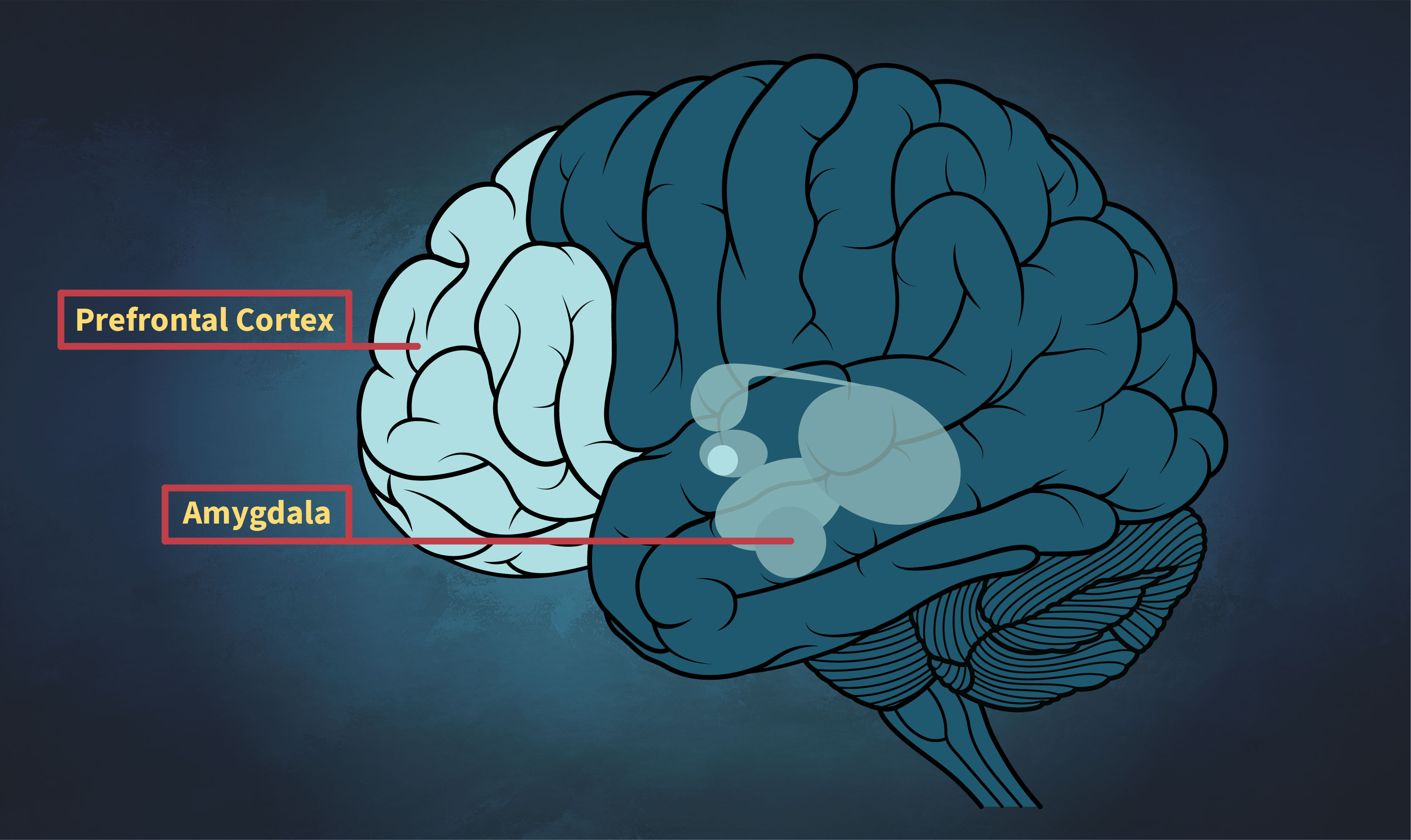
The problem is simple: it can't distinguish between high stakes and wrong action. It just knows something important is happening and flags it as potential threat.
What you need for hard decisions is the slow system—your prefrontal cortex—the part that actually runs calculations, weighs trade-offs, and references your values. That system can do the math.
So when fear screams, you listen.
But you don’t let it decide.
Three Ways Fear Misleads You
Before you analyze fear, know its most common mistakes:
It confuses high stakes with bad choices. High stakes ≠ wrong choice. It just means the choice matters.
It often points at the wrong variable. “I’m afraid of being poor” often masks “I’m afraid of being trapped.”
It mistakes inherited beliefs for your own values. “I should stay because it’s stable” might really be “my parents survived by choosing stability but that’s their formula, not mine.”
Your job isn’t to eliminate these distortions. It’s to recognize them and look deeper.
How to Read Fear
Here is how you use it:
Name the obvious fear
Test it: “If that was completely solved, would I still be afraid?”
If yes, there’s something beneath it. Name that.
Repeat until you find no other fears
Keep going until you hit the fear you wouldn’t want to say out loud. That’s usually the real one. For each fear, update the Gain, Loss, and Reason. Those answers feed the calculation.
Watch how the same decision became completely different math once I analyzed what fear was actually warning me about when I was deciding whether to leave my job.
The Career Exit: A Calculation in Progress
My Initial Calculation
Loss: Leave a company that is core to how I see myself
Gain: Stay living where I want to live
Reason: So my kid doesn’t have to leave her school
What am I afraid of? I think I’m afraid of leaving the company I dedicated 20 years of my life to, a place that feels “like home.”
I collected data: I talked with people who left this company and went on to work at other places. They were generally happy to have left. They were encouraging.
But I was still afraid. If I was likely to be okay working somewhere else...
What am I afraid of? I think I’m afraid of losing financial security.
I collected data: I considered jobs with similar or higher compensation. I interviewed at different companies. But I was still afraid. A higher-paying job would solve the money problem.
Why was the fear still there?
I realized I was scared to end up in a job that didn’t suit me just because of the money. So I considered: if the work is enjoyable, am I willing to get paid less? The fear got smaller. I knew I was hunting in the right direction. So I updated my calculation.
What if I took less money for work I actually wanted to do? I thought through the lifestyle changes I might have to make. How much less would I accept? A lot, it turned out. That surprised me. But even imagining that scenario—doing work I’d enjoy—something still felt unsettled.
If I would be okay leaving the company, if I could enjoy the work, if I was willing to get paid less, then why was I still feeling scared?
Then it came to me:
I was afraid of ending up in the same cage with nicer wallpaper.
The fog cleared. Fear was still there, but it wasn’t noisy.
Misalignment was always a Loss in my equation. Analyzing Fear made it visible.
Once I named it, I could finally calculate accurately.
My Final Calculation
Loss: Some income, corporate stability, the identity of “P&G executive,” certainty about the future
Gain: Work I’d actually enjoy, flexibility in my schedule, fewer working hours, living in Seattle, building something aligned with who I am
Reason: I am meant to build something that helps people, but I keep ignoring my calling. I can’t teach my daughter to live authentically if I’m modeling self-betrayal every day.
The calculation changed completely. Income became one variable among many. Alignment went from invisible to the dominant Reason. And suddenly I had more Gains than I’d realized—flexibility, autonomy, purpose.
Same decision. Different equation. All because I debugged what fear was actually warning me about.
But most important was the Reason it helped uncover: I could tolerate higher uncertainty and financial risk if I was building something aligned with who I actually am. That Reason—that why—made the trade-offs something I could consider instead of paralyzing.
This was part of my calculations. Analyzing what fear was warning about helped me get better inputs. And better outcomes come from better inputs.
When you get that clear about what’s actually at stake, it doesn’t eliminate the fear. But it quiets the noise enough to decide IF you want to act, even if you don't yet know HOW.
📝 Your Turn
Think of a decision you’re facing where fear is loud.
Name the obvious fear. The one you’d tell someone if they asked.
Now test it: “If that fear was completely solved—money handled, approval secured, safety guaranteed—would I still be afraid?”
If yes, keep going. Repeat until you hit the fear you wouldn’t want to say out loud.
For each fear you uncover, ask: Does this reveal a Gain I care about? A Loss I'm facing? A Reason that drives me?
Write it down in the right part of your equation. Update the calculation.
Sometimes analyzing fear is quick. Sometimes, as it was for me, it takes months. That’s legitimate work—legitimate math.
But here’s what changes once you know how to read fear: You stop waiting for courage to arrive. You start debugging the equation until the calculation is clear enough to act on.
When you get that clear about what’s actually at stake, it doesn’t eliminate the fear. But it quiets the noise enough to decide IF you want to act—even if you don’t yet know HOW.
Because courage was never about feeling ready. It was always about having better inputs.
Next week, we'll tackle what happens when fear analysis reveals the truth: you know what you need to do, but you're still not moving. That's when waiting itself becomes part of the calculation.

P.S.: A side note for parents of little kids: Fear, like a child, can be challenging on your nervous system. It lacks the vocabulary to communicate clearly. I try to approach it as I do my daughter when she’s sleeping... when I can just observe her without the constant demands, the negotiations, the mental load. When my nervous system finally calms down enough to feel that uncomplicated love. In the thick of it, it’s exhausting—too much stress and reaction. But when I can step back and look at it from the outside, I remember: it’s here to help me.